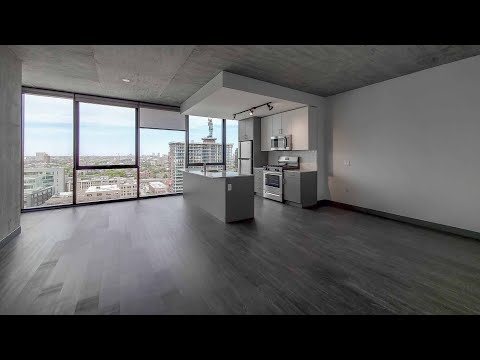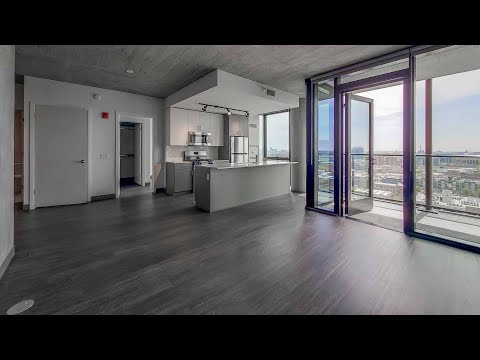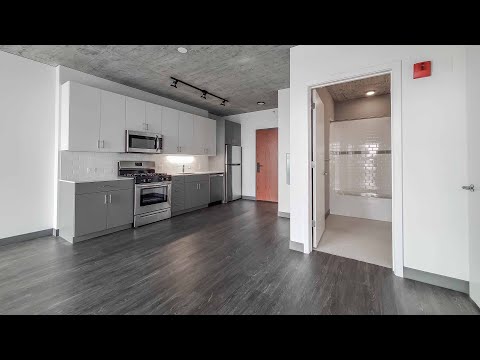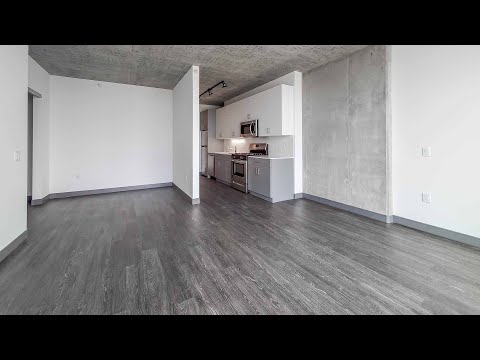
We hear plenty of assurances from developers that things are going smoothly in today's market. But when pressed to back their claims, many of those developers fall silent. Not Brian Giles of Kargil Development and Frankel & Giles. In the August issue of New Homes, Giles says things are going just swimmingly at his companies' two South Loop projects, Prairie District Lofts and X/O Condominiums.
“I have the numbers right here, so I can tell you that as of today, we’ve sold 72 of the 116 units at Prairie District Lofts, and we’re averaging about a sale a week these days,” Giles said in late July.
Prairie District Lofts, one of two developments Frankel & Giles is marketing in the South Loop, is one of the neighborhoods last “true loft” projects, Giles says. The timber and concrete lofts are inside a 103-year-old brick building in the 1700 block of South Indiana Avenue. The building was home to a commercial photography company before being converted into rental apartments; Kargil spent $36 million transforming those units into one- to three-bedroom condominiums.
The lofts range in price from the $200s for a one-bedroom/one-bath, single-story unit to the $520s for a three-bedroom/four-bath duplex. Each home has exposed brick walls, timber or concrete elements per plan, fireplaces, hardwood floors, and ceiling heights of 12 to 20 feet. Features in upgraded homes include GE stainless-steel appliances, granite countertops, Grohe chrome fixtures and 42-inch Cardell cabinets.
Some as-is units are available for immediate delivery. Buyers who desire upgraded units can be in their homes within eight weeks.
I was thumbing through an old copy of the New York Times Magazine recently and came across a short item about the U.S. Green Building Council's Leadership in Energy and Environmental Design certification process (better known as LEED certification). LEED has become the standard bearer for green design, making it pretty easy for developers to brand their projects as environmentally friendly by following a checklist of requirements.
The LEED scoring system still has some wrinkles to iron out. While it usually costs developers more money to jump through all the hoops that are necessary to obtain LEED certification, there's little evidence that a LEED-certified building will actually be more environmentally sustainable than one that hasn't sought certification.
Here's what the NYT had to say about LEED:
Developers end up having to bring in a small army of consultants and reviewers to approve every step… At the same time, if you’ve got the cash, LEED is an easy system to game. As critics like to point out, a $395 bike rack and a multimillion-dollar low-energy A.C. system both get one point. Nor does the point system consider regional particularities; two critics wrote in a 2004 paper that “water conservation is more of a priority in hot, dry climates, yet the U.S.G.B.C. awards the same number of credits for water conservation in Seattle as in Phoenix.”
Some other criticisms in the NYT piece are that the LEED process doesn't take into consideration the life cycle of buildings and the maintenance they will require down the road, and that the system puts forth "proscriptive requirements" that discourage innovation.
The U.S. Green Building Council is responding to criticism, and they're set to modify standards in January. According to a press release, "points will be allocated differently and reweighed, and the entire process will be flexible to adapt to changing technology, account for regional differences and encourage innovation."
What's the benefit of having a single governing entity like the U.S. Green Building Council? Is LEED certification even important anymore?
In condo construction, timing is essential. Terrie Whittaker, president of sales and marketing for New West Realty, says that her company acquired the land at 1555 S Wabash Ave in the South Loop at just the right moment.
“We were just finishing up a very successful project close by, and we had a solid handle on the neighborhood," she says.
In the August issue of New Homes, writer Dan Schuyler interviews Whittaker and architect Jonathan Splitt about 1555 Wabash, New West's new 14-story, 176-unit condominium tower. In the story, Splitt explains how he came up with the building's eight-cornered design.
While the location did not lend itself to a specific type of structure, the proximity of the train tracks and several contemporary buildings helped Splitt formulate a design scheme for 1555 Wabash.
“We wanted to borrow from the solid, massive image of the trains by keeping the base of the building fairly dense,” Splitt explains. “From the third floor on up, we went with all glass and steel in a unique criss-cross design that provides eight corner units per floor and allows for larger, yet more intimate terraces, while taking advantage of the gorgeous views. It also gave us the opportunity to use two shades of tinted glass, depending on the direction of the outside exposure.”
The result is a gorgeous structure that is as functional as it is pleasing to the eye. But there’s more. Images of Lake Shore Drive in the 1930s come to mind as one approaches the building via a covered vehicle turnaround that invitingly guides the user to the entrance.
“The driveway serves to shorten the distance to the soul of the building once you’re inside,” says Splitt. “And the interior glass lobby wall serves an informative function. The user doesn’t just enter and scan around to figure out where to go. It’s all very gracious and natural.”
Every morning, we comb through scores of local and national newspapers and magazines, amateur and professional blogs and other interesting Web sites in search of stories that are relevant to Chicago home buyers. We add those stories to own news feed, thereby creating a one-stop news source for anyone interested in Chicago's neighborhoods and new-home market.
In the final video of my first-time buyer series with Carol Dorsey, we stopped off at a high-rise at 210 S Desplaines St to check out another resale unit. This time the owner, Frank Casto, was home, and he took a few minutes to talk to us about his condo and his business making window treatments.
In a soft market, judicious buyers want to have as much say in the look and feel of their new homes as possible before they sign on the dotted line. This isn't a problem for Jon Zitzman. In fact, the head of JFJ Development welcomes buyers who wish to customize their condos.
In the August issue of New Homes, writer Andrew Peck talks to Zitzman about his new River North tower, Superior 110, a place where homeowners have the ability to customize every inch of their living space.
“When I founded my company 15 years ago, my mission was to provide more quality construction than a majority of the market was offering,” Zitzman says. “My goal was to build a reputation over time as a developer who doesn’t cut corners and conducts business at the highest level of integrity. Building custom condos is an extension of that philosophy.”
Buyers have a number of options within Snaidero’s standard line of cabinetry and bathroom finishes. But every buyer has the ability to meet with a design coordinator at a design showroom and can choose from literally any of the products found there.
“If somebody wants something specific built in, they can get it,” says Greg Eldridge, the @properties sales agent in charge of marketing Superior 110. “People come in all the time and say, ‘I saw this tile at the Merchandise Mart and I’ve just got to have it.’ And if we can get it, we’ll get it.”
According to Eldridge, Zitzman’s unique attention to the needs of his buyers allows JFJ to provide a “wildly unique” personal touch to their projects.
“Because we pay an enormous amount of attention to the construction and finishes, our team grew accustomed to entertaining buyers’ specials requests,” Zitzman says. “As a developer, I’m involved in the construction process. So I spend a lot of time looking at new technologies and products on the market, which affords us the opportunity to do more custom finishes.”
It's not often that the owners of a business toil unheralded as support troops. Yet that's been the case at New Homes Magazine / YoChicago, where Valerie Zekas has worked as a sales assistant while her brother Jordan handles distribution for his magazine.
Today was Valerie's last day at New Homes / YoChicago. It's a bittersweet day for the business, but one of unalloyed joy and pride for her indirect supervisor, her dad. Valerie will be pursuing a master's degree, with a concentration in nonprofit housing development, at Milano, The New School, in New York.
After looking at some vintage lofts in Printers Row and a condo conversion in the South Loop, Carol Dorsey from Prudential SourceOne Realty took me over to the West Loop to have a look at a newer condo (but a resale, nevertheless). There, at 1001 W Madison St we looked at a two-bedroom corner unit that was recently reduced to the $390s. Stay tuned for the fifth part of the "First-Time Boyer" series, which will be posted on YoChicago soon.
Lauren Schreyer of Koenig & Strey GMAC Real Estate said today that she's optimistic that Paramount will go ahead with Polk Street Station in Printers Row. Originally, this development had been called the Row Homes of Printers Row, and it was to include five row houses on the vacant parking lot at 777 S Dearborn St.
The current plans for 777 S Dearborn St call for about five three- to four-bedroom duplexes, and they sound pretty similar to those that Kate described last September, but Schreyer says the developer also plans to build seven full-floor units across the street, on the west side of Dearborn. Schreyer says that those full-floor units would be a bit bigger, clocking in at 2,700 to 3,500 square feet.
Schreyer plans to meet with the developer soon to find out if and when this development will get moving, but she hopes ground will break by the end of the year.
In the August issue of New Homes, Dan Schuyler talks to the team behind The Superior at LaSalle about the design of this 15-story, 54-unit tower in River North and asks why the building is attracting such a broad spectrum of buyers.
“The team put together a terrific package,” says sales and marketing manager Eric Dick, “Features like 15-foot ceiling heights, two walls of glass in each unit, and finishes that are a step above the competition. They explain why we are attracting buyers ranging from working professionals to empty nesters to second-home seekers. It runs the entire gamut.”
The area has undergone rapid change, according to Hartshorne Plunkard partner Tom Pope, who says that The Superior’s beige limestone and the fusion of neo-classical and art-deco looks capture the surrounding color palette and building shapes.
“The building program really drove the design in the long run,” says Pope. “The structure is a series of three projections with emphasis on verticality, and it includes a lot of reveal detail. The solid glass corners define large duplex units that have the feel of townhomes and are appealing to the multi-level market. And the painted limestone façade and champagne-tinted glass blends in with the surroundings and gives the building a warm, intimate feel.”